Berlin History-Focused Itinerary: Weimar, Nazi Era, Cold War in 3 Days
A three-day Berlin history walking itinerary covering Weimar collapse, Nazi power, the Holocaust, the Wall, and reunification. Includes Bendlerblock, Wannsee, Karlshorst, Gleis 17, Treptow — sites most itineraries miss.
Berlin is the rare European capital where the 20th century didn’t happen in the past tense. It happened here, repeatedly, decisively, often catastrophically, and almost always within a few hundred meters of where you’ll be standing. Weimar collapsed at the Reichstag in 1933. Nazi power was administered from buildings on Wilhelmstraße. The Holocaust was planned at a lakeside villa on the Wannsee. The Wall went up on a Sunday in August 1961 and came down on a Thursday in November 1989. The Soviet surrender was signed in a school cafeteria in Karlshorst. If you want to walk this century — not read it, walk it — Berlin is where you do it.
This itinerary is built for the traveler who wants more than the headlines. It’s a three-day plan that threads the Weimar collapse, the Nazi era, the Cold War, the Wall, and reunification into a coherent, geographically-organized walking route. It doesn’t replace a serious read of Richard Evans or Mary Fulbrook, but it does what no book can: it shows you the rooms, the streets, the pavement markers, the brass stumbling stones underfoot. Three days will not exhaust this city’s historical layer. It will give you a framework you can return to.
How to Approach Berlin’s History Sites — A Few Practical Notes
Pacing. Two emotionally heavy sites per day is the ceiling. After Topography of Terror plus the Memorial to the Murdered Jews of Europe, you’re done — your brain stops absorbing. Build in coffee breaks; sit in parks; eat real meals. The point is to feel this, not to checklist it.
Stolpersteine. Look down as you walk. The brass cobblestones with names, birth dates, and deportation/death dates are German artist Gunter Demnig’s project, started in 1992. Over 100,000 stones have been laid across Europe, the majority in Germany. Berlin has thousands. Each one marks the last freely-chosen residence of someone murdered or persecuted by the Nazis. They’re not signposted; they’re meant to be discovered. Reading them as you walk is a practice — and a deliberate slowing-down.
Free vs. paid. Most of Berlin’s important historic sites are free: Memorial to the Murdered Jews of Europe, Topography of Terror, Berlin Wall Memorial at Bernauer Straße, Tränenpalast, German Resistance Memorial Center (Bendlerblock), House of the Wannsee Conference, German-Russian Museum Karlshorst, Soviet War Memorial Treptow. Paid: Jewish Museum (€8), DDR Museum (€13.50), Stasi Museum (€8), Hohenschönhausen Prison (€6 guided tour, must be booked ahead for English), Mauermuseum at Checkpoint Charlie (€17.50). The Reichstag dome is free but requires advance registration at visite.bundestag.de.
2026 closure to know: The German Historical Museum’s Zeughaus is closed for renovation; heavy demolition begins Q2 2026 and runs into 2027, with the full Zeughaus reopening date undetermined. The adjacent Pei Building is hosting “Objects. History. Stories: A Look into the Collection” from May 8, 2026 to October 31, 2027 — visit the Pei Building, not the Zeughaus, on your history day.
Day 1 — Mitte: Weimar Collapse Through Nazi Power (Chronological Walking Route)
This is the day to start. The route is geographically tight — 4.5 km, 5–6 hours with stops — and roughly chronological, taking you from the collapse of Weimar democracy through the consolidation of Nazi power into the war and its aftermath.
9:30 a.m. — Reichstag dome (pre-booked at visite.bundestag.de, free). The 1894 building is where Weimar democracy collapsed: the February 1933 Reichstag fire (whether or not Marinus van der Lubbe acted alone, the regime used it to push through the Reichstag Fire Decree, suspending civil liberties) gave Hitler the constitutional opening. Norman Foster’s 1999 dome — the audio guide narrates this — was designed as a literal reinscription of democratic transparency over the wound. 60 minutes.
11:00 a.m. — Brandenburg Gate. The Quadriga atop the gate was stolen by Napoleon in 1806 and returned in 1814. The gate itself was a Nazi parade site, a frontier of divided Berlin (it stood in the dead-zone between East and West from 1961 to 1989), and the site of Reagan’s 1987 “tear down this wall” speech. Stand under it and you’re standing on a hinge.
11:30 a.m. — German Resistance Memorial Center (Bendlerblock). Tucked into the Tiergarten just south of the Reichstag, in the courtyard where Claus von Stauffenberg and his co-conspirators were shot on the night of July 20, 1944, after their assassination attempt on Hitler failed. Free, allow 60 minutes. This site is almost universally skipped by tourist itineraries — the SERPs barely mention it — and yet it’s one of the most important German Resistance memorials in the city. The exhibition documents not just the July 20 plot but the broader spectrum of resistance: communist, Christian, military, Jewish.
1:00 p.m. — Lunch at Augustiner am Gendarmenmarkt. Walk back through the Tiergarten to Mitte, then east to the square. Hearty Bavarian, the right caloric base for a heavy afternoon.
2:30 p.m. — Memorial to the Murdered Jews of Europe. Peter Eisenman’s 2,711 concrete stelae and the underground Information Center (free, ID-style timed entry, closed Mondays). The Information Center’s Room of Names is the slowest, hardest 30 minutes of your trip — pre-recorded readings of names and biographies of the murdered. Allow 90 minutes total.
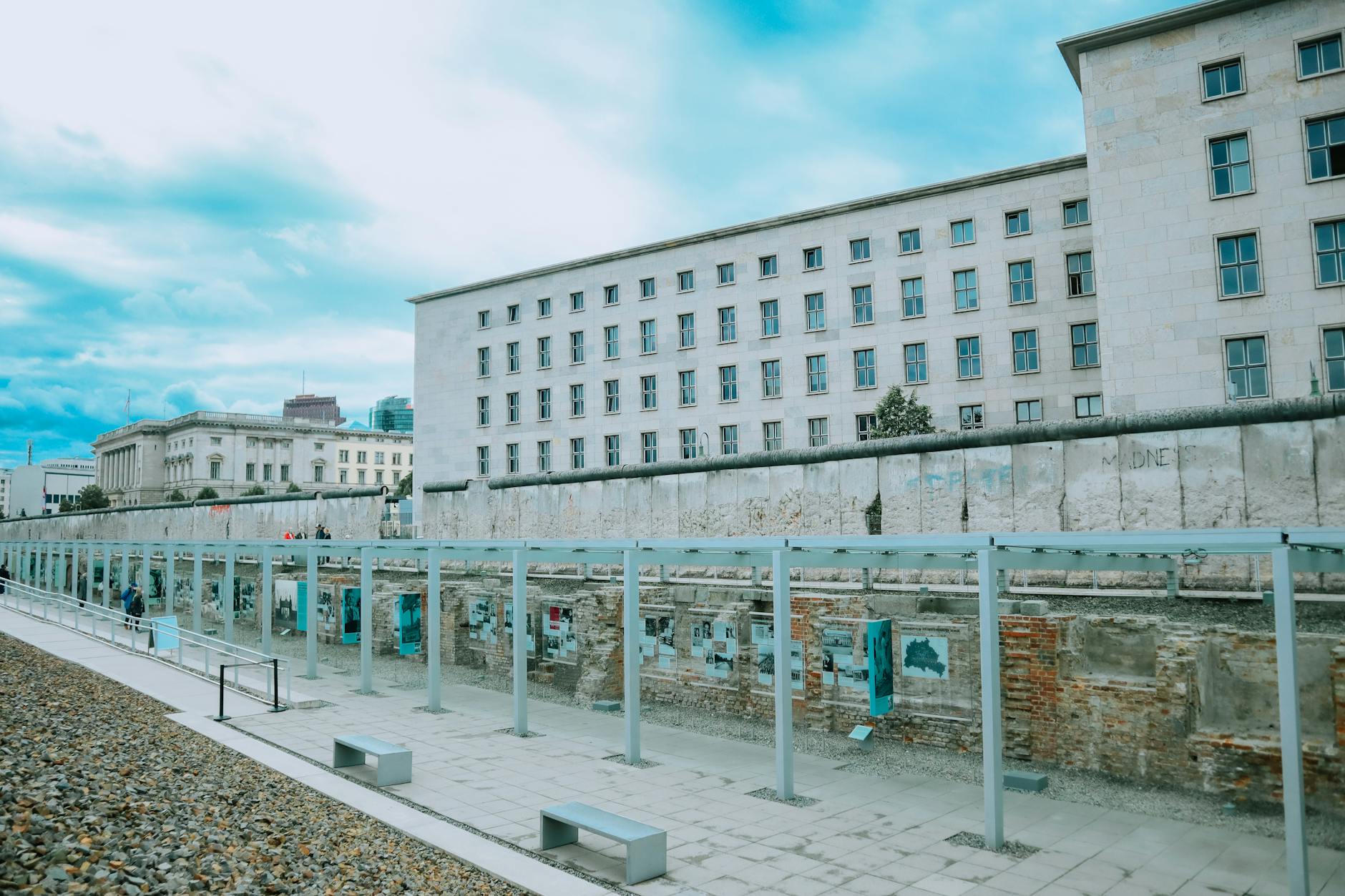
4:30 p.m. — Topography of Terror. Walk south down Wilhelmstraße, reading the pavement and bus-stop markers that identify which ministry stood where (Goebbels’ Propaganda, Göring’s Air, the Reich Chancellery, the Foreign Office). The Topography of Terror occupies the foundations of the former Gestapo, SS, and Reich Security Main Office headquarters. The outdoor exhibition along the 180-meter remaining Wall stretch covers the SS apparatus; the indoor pavilion covers the broader Nazi state, occupation, and aftermath. Free, daily 10:00–20:00, allow 2 hours.
6:30 p.m. — Bebelplatz. Walk north to the square in front of Humboldt University. On May 10, 1933, Nazi students burned 20,000 books from the university library here — Heinrich Heine, Bertolt Brecht, Karl Marx, Thomas Mann. Look for Micha Ullman’s Empty Library memorial under the glass plate in the center of the square — a sunken white room of empty bookshelves, designed to hold the 20,000 burned volumes. The Heine quote on the plaque: “That was but a prelude; where they burn books, they will ultimately burn people too.” Written in 1820.
7:00 p.m. — End at the Anne Frank Center + Otto Weidt’s Workshop for the Blind (Rosenthaler Straße 39, in the Hackescher Höfe complex). The Anne Frank Center is small and Berlin-focused; the Workshop for the Blind, in the courtyard next door, is one of the city’s most quietly devastating sites. Otto Weidt was a brush-and-broom workshop owner who employed and hid blind and deaf Jews during the war. The workshop preserves the back rooms where he sheltered the Horn family. Free, both close by 19:00 — adjust your day if needed.
Dinner at Restaurant 3 Minutes Sur Mer (modern French in the Scheunenviertel) or Mogg (pastrami at the historic Jewish Girls’ School). Both are emotionally appropriate as endings.
Day 2 — Cold War: The Wall, the Stasi, Bernauer Straße to East Side Gallery
Day 2 is the divided-city day. The Wall went up on Sunday, August 13, 1961, and stood until November 9, 1989. The route below moves roughly chronologically through what the divided city looked like and what its dismantling looked like.
9:30 a.m. — Berlin Wall Memorial at Bernauer Straße. The most rigorously-built Wall site in the city — most people who skip it go to East Side Gallery instead and miss the point entirely. Bernauer was a street where the building facades stood in East Berlin while the sidewalk lay in West Berlin; in 1961 East German police walled up windows and the residents who’d jumped out before the wall-up are commemorated by name. The site includes: a preserved 60-meter cross-section of the Border Strip with watchtower, signal fence, and death strip; the Documentation Center; the Chapel of Reconciliation (built in 2000 on the death strip exactly where the destroyed 1894 Church of Reconciliation stood); an outdoor exhibition spanning 1.4 km; and a viewing tower from which you can see the death-strip layout in full. Free, allow 2 hours.
12:00 p.m. — Tränenpalast (“Palace of Tears” at Friedrichstraße station). The former East-West border crossing point for day visitors from the West; “tears” because this was where you said goodbye to family on the other side. The small, free, beautifully-curated exhibition documents what crossing meant in daily life: the smell of GDR disinfectant, the East German guard’s surveillance, the small bag of contraband Western goods you’d risk being caught with. 45 minutes.
1:00 p.m. — Lunch at Mehringdamm. Take U6 south. Curry 36 + Mustafa’s Gemüse Kebap are adjacent. The currywurst itself has Cold War significance — it’s a West Berlin invention from the late 1940s, born of British Army ketchup and German sausage during occupation.
2:30 p.m. — Checkpoint Charlie + Mauermuseum. The site is now largely reconstructed kitsch — fake American soldiers, McDonald’s, gift shop. The actual Cold War checkpoint was disassembled in 1990. But the Mauermuseum (Haus am Checkpoint Charlie, €17.50) opened in 1962 right beside the checkpoint and is itself a Cold War artifact — its founder, Rainer Hildebrandt, documented escape attempts in real time during the divided years. The escape stories — hot air balloons, tunnels, ramming the border with cars — are extraordinary. 90 minutes.
4:30 p.m. — Jewish Museum. Daniel Libeskind’s 2001 building is itself a Holocaust memorial (the Holocaust Tower, the Garden of Exile with its disorienting tilted ground, the Memory Void’s Menashe Kadishman Shalekhet floor of iron faces you walk across). The permanent collection runs from medieval Ashkenazi life to the present. €8, allow 2 hours.
6:30 p.m. — East Side Gallery at golden hour. U-Bahn or S-Bahn to Warschauer Straße / Ostbahnhof. The 1.3 km of preserved Wall painted by 118 international artists in 1990 immediately after reunification. Walk west-to-east starting at the Ostbahnhof end — the murals face south, the afternoon sun lights them. Dmitri Vrubel’s “My God, Help Me to Survive This Deadly Love” (the Brezhnev-Honecker kiss), Birgit Kinder’s Trabant breaking through, Thierry Noir’s brilliant naive heads. 60 minutes.
8:00 p.m. — Dinner in Friedrichshain. Modern German at Mr Susan on Schlesische Straße or Vietnamese at Lemon Leaf. Talk through what you’ve seen with whoever you’re traveling with. This is when the day lands.
Day 3 — Deep Cuts: Wannsee, Gleis 17, Karlshorst, Treptow
Day 3 is where most history-focused itineraries stop and where this one starts paying real dividends. The sites below are outside central Berlin, generally free, generally uncrowded, and consistently rate among the most affecting experiences travelers report. They require an early start and a S-Bahn pass.
9:00 a.m. — House of the Wannsee Conference. S7 to Wannsee, then bus 114 to Am Großen Wannsee. The villa where, on January 20, 1942, 15 senior Nazi officials (chaired by SS-Obergruppenführer Reinhard Heydrich) met for 90 minutes over breakfast and coordinated the bureaucratic implementation of the Final Solution. The minutes — taken by Adolf Eichmann — survived and form the spine of the exhibition. Free, daily 10:00–18:00. Allow 90 minutes. The lakeside setting is beautiful, which makes the visit harder.
11:30 a.m. — Gleis 17 / Track 17 at Grunewald S-Bahn. Back to Wannsee, S7 toward central Berlin two stops to Grunewald. The platform behind Grunewald station from which more than 50,000 Berlin Jews were deported to the death camps between 1941 and 1945. The memorial — steel plates set in concrete along the platform’s edge, listing each deportation date, the number of people, and the destination camp — is by Nicolaus Hirsch, Wolfgang Lorch, and Andrea Wandel. Walk the platform from end to end; read the dates. Free, accessible 24 hours. Allow 45 minutes. Almost universally skipped by English-language itineraries; absolutely essential.
1:00 p.m. — Lunch in Grunewald or Wilmersdorf. Light, then back on the S-Bahn east.
3:00 p.m. — German-Russian Museum at Karlshorst. S3 to Karlshorst, then 10-minute walk. The former officers’ mess where, in the early hours of May 8/9, 1945, the unconditional surrender of the Wehrmacht was signed in front of Marshal Zhukov. The exact table and chairs are preserved in the room. The museum extends the story into Nazi-Soviet relations, the war on the Eastern Front, occupation, and post-war divided Germany. Free, closed Mondays, allow 90 minutes. This site is almost criminally under-covered in English-language Berlin guides.
5:00 p.m. — Soviet War Memorial Treptow. S-Bahn to Treptower Park. The largest Soviet war memorial outside the former USSR, completed in 1949 in Treptower Park. A 12-meter statue of a Soviet soldier carrying a German child, sword drawn, standing on a broken swastika, anchors a mass grave of 7,000 Red Army soldiers killed in the Battle of Berlin. The scale is overwhelming; the political reading shifts depending on the visitor. Free, accessible 24 hours, allow 45 minutes.
7:30 p.m. — Dinner in Kreuzberg or Neukölln. Decompression at Joseph-Roth-Diele in Schöneberg (the literary tavern dedicated to Joseph Roth, the Jewish-Austrian writer who fled Berlin in 1933 and never returned — appropriate closing dinner) or Eins44 in Neukölln for a set menu in a former distillery.
The Stasi Day (Substitute for Day 3 If You Skip the S-Bahn Sites)
If the Cold War interests you more than the Holocaust narrative — or if Day 3 above feels too dispersed — substitute a Stasi-focused day in Lichtenberg.
Morning: Stasi Prison Hohenschönhausen (€6, guided tour only, must book English tours in advance at stiftung-hsh.de). The Ministry for State Security’s central remand prison. Tours often led by former inmates; the experience is unsparing. 2 hours.
Afternoon: Stasi Museum in the former Stasi headquarters at Magdalenenstraße/Ruschestraße (Erich Mielke’s office preserved exactly as he left it in 1989). €8, allow 90 minutes.
Evening: Friedrichshain. Decompress.
The Walking Tour Question
Should you book a guided walking tour? Honest answer: yes, for at least one segment. The Day 1 Mitte route is doable as a self-guided walk with this article and a guidebook, but a knowledgeable guide adds 30–50% more context than you’ll otherwise pick up. The two operators consistently recommended in serious travel writing are Original Berlin Walks (running since 1993, Cold War and Third Reich specialists) and Insider Tour (smaller groups, broader thematic range). Avoid the “free” tip-based tours for serious history — guides earn their living on volume and the experience is less rigorous.
A specialty tour worth considering: Berliner Unterwelten (“Berlin Underworlds”) in Gesundbrunnen runs guided visits into WWII bunkers, Cold War civilian fallout shelters, and the abandoned tunnels of the divided city. €15, advance booking essential, 90 minutes.
What This Itinerary Doesn’t Cover (And Why)
Berlin’s historic layer has more sites than any three-day plan can hold. A few I’ve consciously omitted from the main route:
Sachsenhausen Concentration Camp Memorial. Treated separately because it requires a full day. S1 to Oranienburg, 20-minute walk. Free, allow 4 hours on site. Our Sachsenhausen day-trip guide covers the visit in depth.
The Berliner Unterwelten WWII bunker tours. Worth adding as a half-day after Day 1 if you have time.
Plötzensee Memorial. The Nazi execution site for the July 20 plotters and many other resistance figures. Free, 30 minutes, pairs naturally with the Bendlerblock visit on Day 1.
DDR Museum. The most popular “GDR daily life” museum is fun and tactile but tonally lighter than the rest of this itinerary. Slot it in if you’re traveling with children or as a Sunday-afternoon stop.
Märkisches Museum. Berlin city history museum, reopening phased through 2026.
For a history day away from the monuments, go to Schöneberg. The steps where Kennedy gave the “Ich bin ein Berliner” speech, the Liberty Bell above them, the pink triangle plaque at Nollendorfplatz and some eighty lamppost signs quoting Nazi anti-Jewish laws in the Bavarian Quarter are all a few U-Bahn stops apart. Our Schöneberg guide joins them up.
One Last Note on Doing This Well
Berlin’s historic sites are not entertainment, and the city — to its considerable credit — refuses to package them as such. The Memorial to the Murdered Jews of Europe does not have a gift shop. The Bendlerblock courtyard is unmarked except for a small plaque and the boots-on-stones spot where Stauffenberg was shot. The brass Stolpersteine are anonymous unless you stop and read them.
The contract the city makes with the visitor who shows up to walk this layer is: take it seriously, give it time, and the city will repay you with something no European capital teaches more honestly. After three days of this, you’ll understand both how Berlin became what it became and how it’s still — sometimes painfully, sometimes beautifully — working through it.
For a counterweight to this itinerary, our art and culture itinerary covers the parallel cultural reawakening of the city since 1989. For practical trip planning, our three-day itinerary mixes history with the broader Berlin canon, and our seven-day plan sequences this history walk over a fuller week. Our spring, autumn, and winter seasonal guides will help you pick the right time — the shoulder seasons are when these sites are most contemplative.